| How to Build Your First Surfboard by Stephen Pirsch |
|
HOME
This is your site. It is not biased by any direct advertising and no money is accepted for any links shown. It is made for you and supported by you. PLEASE DONATE!
HALL OF FAME Mark Sadler |
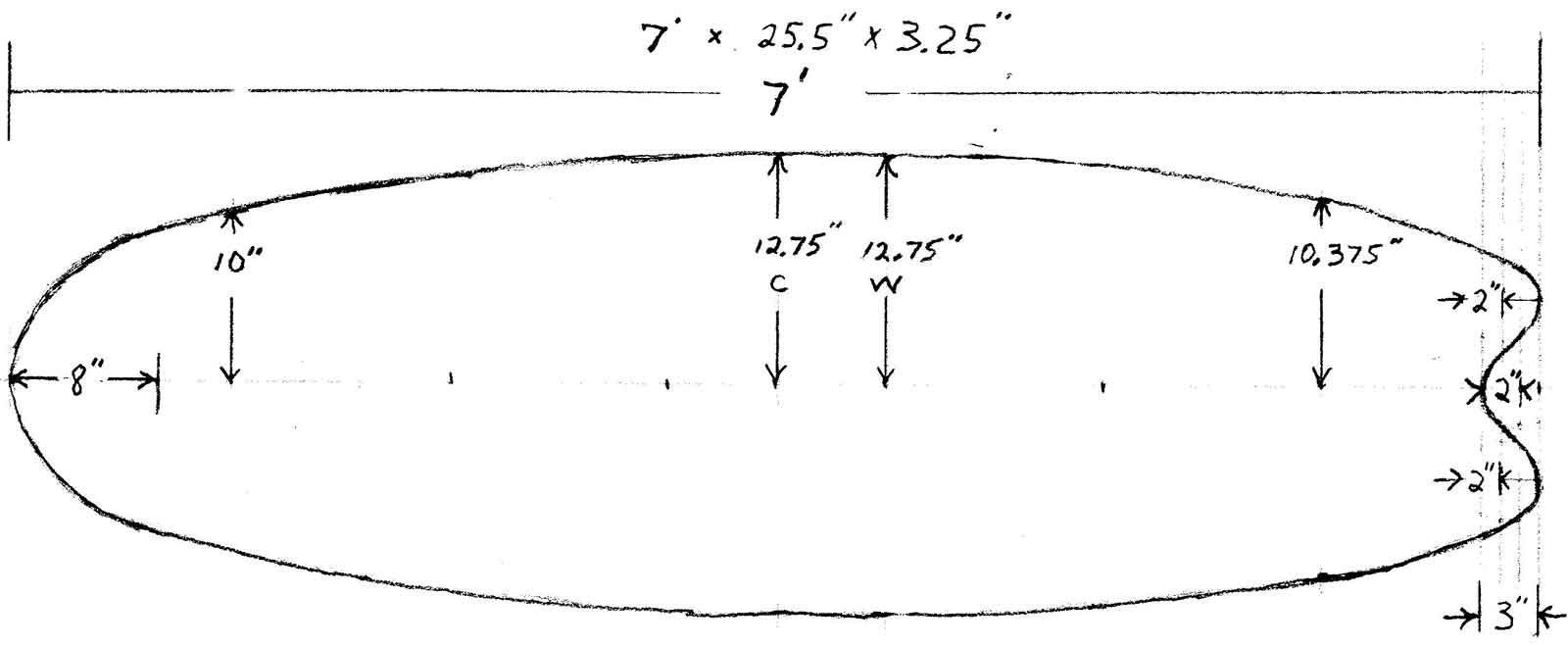
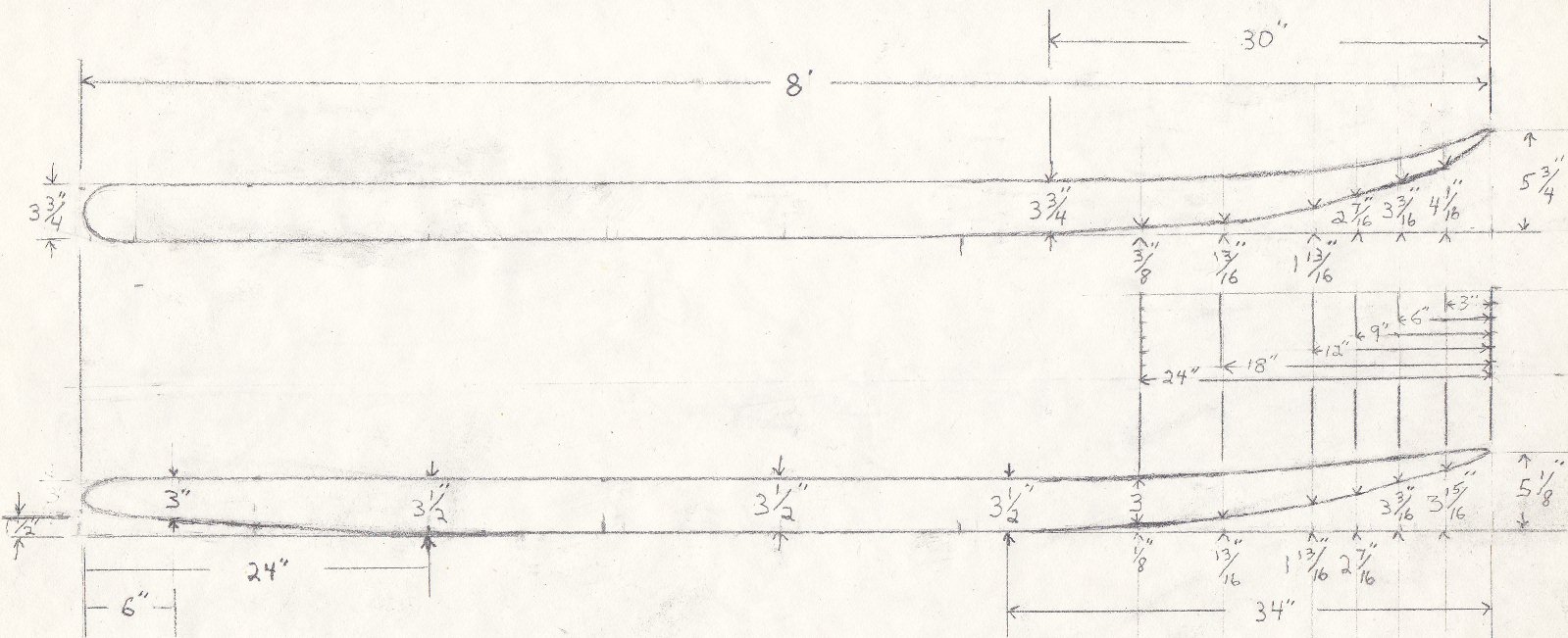
SMALL WAVE DESIGN My friends and I have been experimenting with a very unusual shape that is suited to slow, small, choppy waves. The following design turns easily at low speeds, creating very little drag in the turn. This shape catches waves like a long - longboard, but is 2' - 3' shorter, and turns easily twice as fast. The design is 7' - 8' long, and 3" - 4" thick,
(depends on surfers weight) with about 2/3 of the total thickness
available 1' from the nose and tail. The fin box is a 7&1/2" Fins Unlimited
type (with this box the fins can be adjusted to a maximum of 13&1/2"
- from the tail end of the board to the trailing fin edge).
The board turns much looser with the fins all the way towards the
nose. The bottom and top are very flat rail to rail.
The rails are almost perfectly round everywhere (much better for
choppy conditions). The blue boards
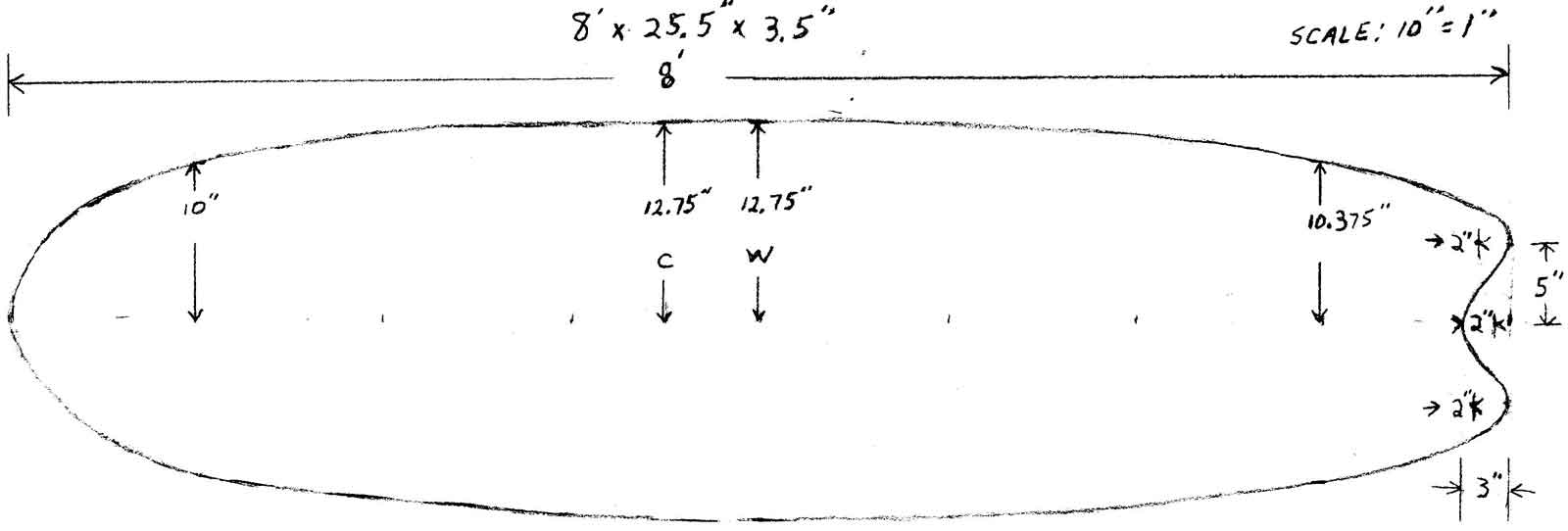
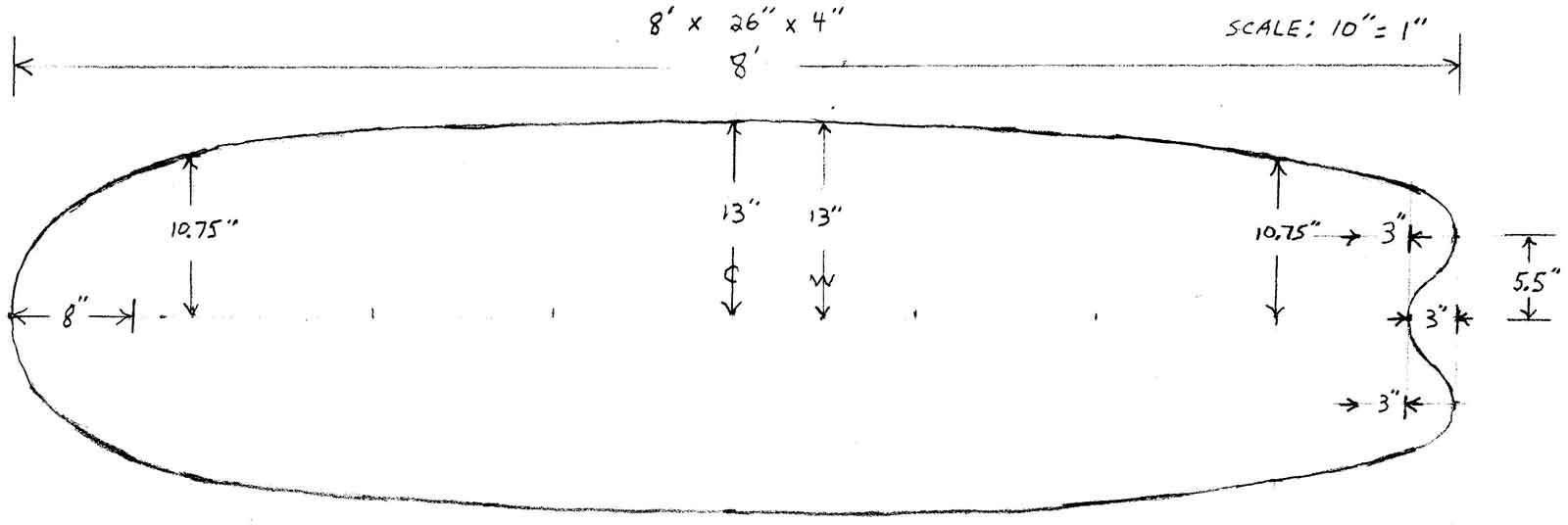
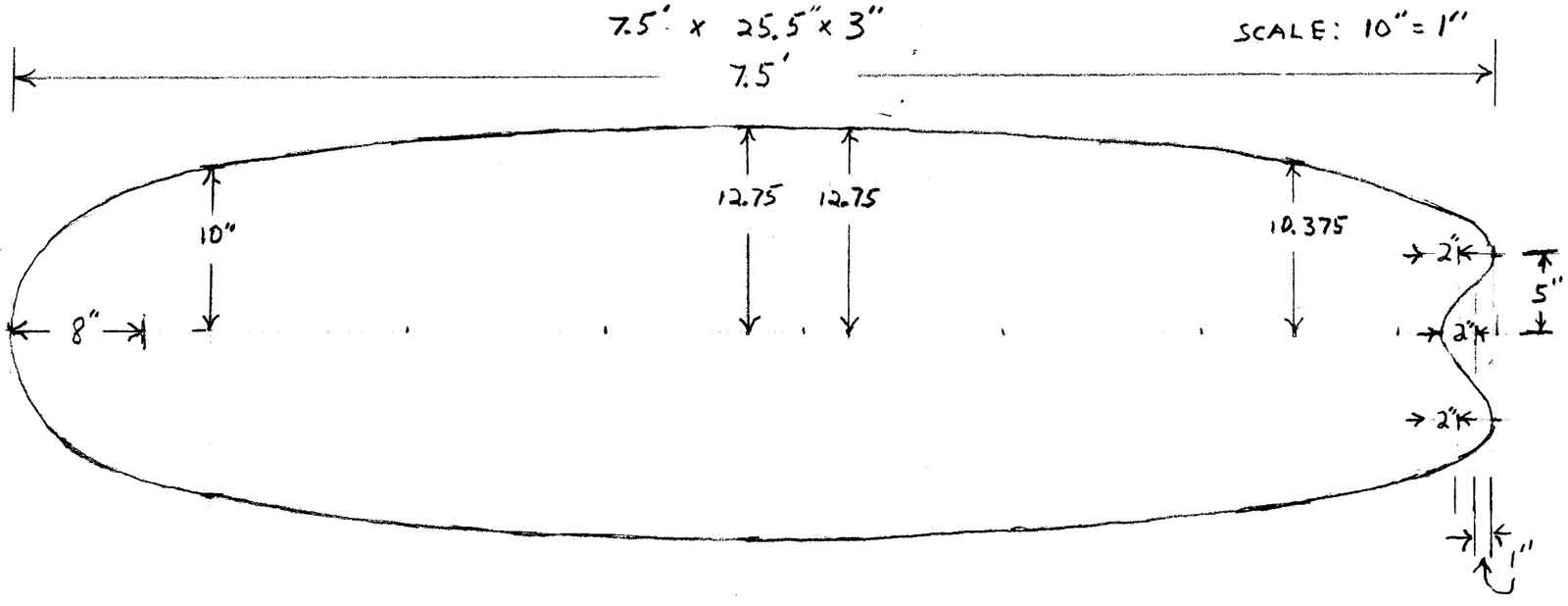
shown in the photos, throughout the book, are small wave designs. A 8' x 25.5" x 3.5" design with the measurements below
will float a 170 lb. surfer with the entire top the board out of
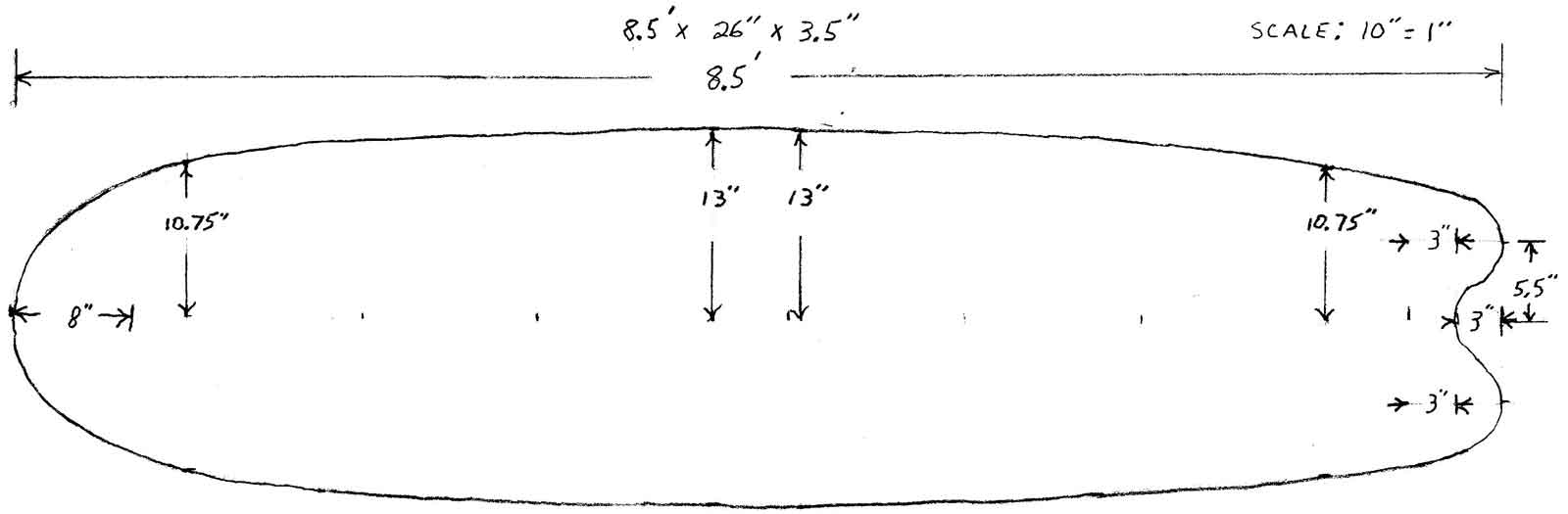
the water. A 8' x 26" x 4" design design with the measurements below
will float a 220 lb. surfer with the entire top of the board out
of the water. As a child, I remember thinking a board with a narrow tail would turn easier (as many ads suggest). At slow speeds just the opposite occurs. A narrow tail will sink at slow speeds, dragging water. A wide tail will plane on top of the water. These boards are designed to be turned by mostly twisting your body, instead of mostly leaning. This will create rotation (swivel) with the board relatively flat on the water, with very little drag. This design has been ridden since 2000, in many conditions, including
double overhead, but that is not remotely what it is made for.
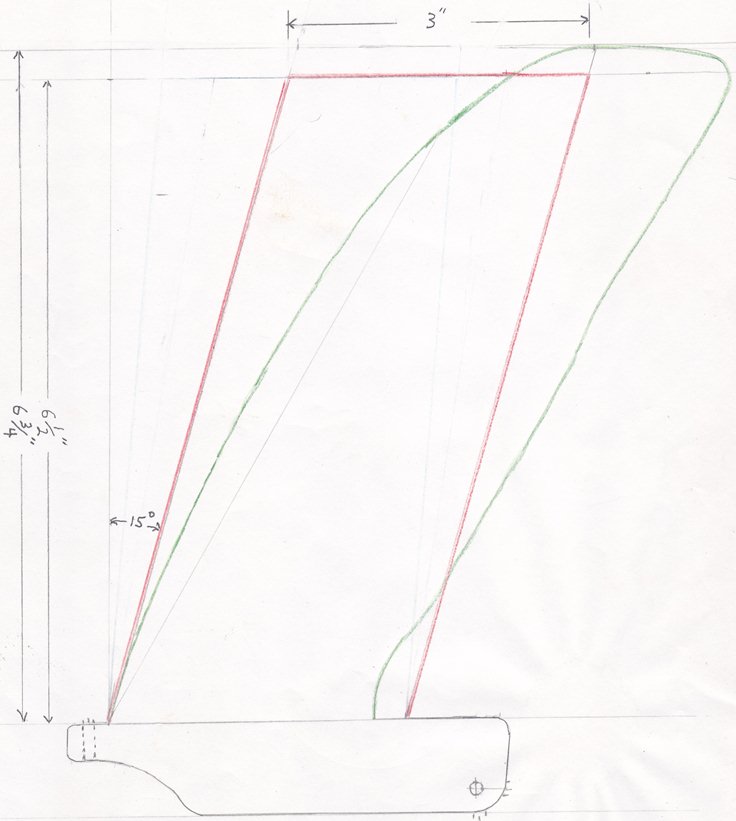
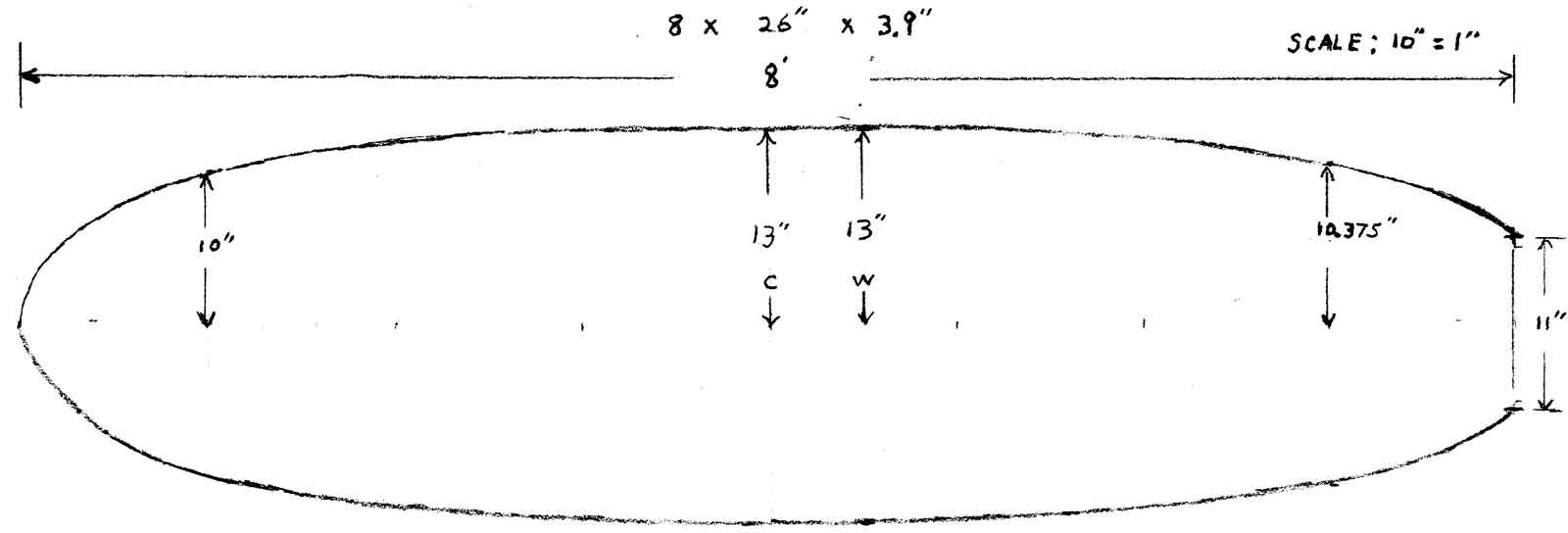
It is best suited to gentle, knee to chest high, choppy waves. NEW SMALL WAVE DESIGN In 2011, according to emails, hundreds, probably thousands, of Small Wave Designs have been home built. Although the general surfing public dismisses the design as an oddity, those who try it often claim there is no other design as well suited to small, slow, choppy surf. Newer Small Wave Designs are here. These are made for even smaller waves - 1' to 3' slow, choppy surf. The new designs have a stiffer, slower turning characteristic compared to the old small wave design - this is due to the new designs being more parallel, and flatter. However; the new designs are significantly better suited to 1' to 3' surf, as they catch waves easier, plane through the flat spots and slow areas better, and turn with even less drag. This low drag is especially useful when coming out of a wave section on to a flat spot. The low drag design allows for a gradual turn back into the steeper section without fading out of the wave face. The older design (relatively curved outline with more rocker and thinner tail) turns faster, and is better suited to slightly larger surf. The drawings below show the earliest and latest versions of small wave designs. On the newer models, for surfers under 160 lbs., the twin fins are modified parallelograms raked at 20 degrees, 3" wide, 6" long (as seen in the green tracing below) - these can be cut from 7" molded cut away fins installed in Fins Unlimited Boxes cut to 5&1/2" long and installed 1&1/8" (or closer) from the rail edge. The boxes are installed with the base higher on the tail end, in order to tilt the fin more towards 20 degrees (more upright, less rake). If over 160 lbs., use 7" molder cutaway fins full size, but do install boxes 1&1/8" from the rail edge, with the base higher on the tail end. Note 1: Sliding the back foot towards the rail greatly enhances turning, in fact, it is unlikely you will ever appreciate the design without doing this. Note 2: The curvature between the various half circles of the noses, and tails, can be created by using a piece of foam 5'x 1/2"x 1/2". At the end of the piece of foam mark the 1/2" thickness at 1/4". Draw a straight line from the Note 3: On the later versions, a 48"x 32"x 1/8" sheet of 90 psi vinyl foam sheet ($29.95 at fibreglast.com) was epoxied on the deck. This sheet is at least 3 times stronger than most surfboard foam, while being only about 50% heavier. This sheet used on the deck patch area (top rear 2/3 of board, starting 12" from tail tip) allows one layer of cloth to be used on the top and bottom and still have a much stronger than average deck area - a lighter and stronger board for roughly $10. more, after shipping, considering the savings on the deck cloth and resin. More labor is involved with the vinyl foam method compared to cloth deck patch method, as you will need to either plane the blank 1/8" to fit the vinyl or sand the vinyl edges flush. You should be able to reduce the weight about 2 lbs. and still have a stronger deck by using vinyl foam compared to an 8oz. cloth deck patch board. Also; expanded polystyrene foam can be be had in 40, 60, 80, and 100 psi sheets. A 60 psi sheet hotwire cut (or cut with a chain saw mounted on a table) to 3/8" thickness and glued to deck patch area makes a deck similar to vinyl foam above.
PLANING HULL A surfboard should be designed as a planing hull. Most are designed with planing aspect ratios (planing width divided by planing length) similar to boats, boats being mostly displacement hulls. For optimal planing a surfboard should be relatively flat, relatively wide, and relatively rectangular. The result can be a surfboard reaching full plane at a lower speed, producing lift and reducing drag. Tests done by Lindsay Lord, a Naval Architect, show that a shape with an planing aspect ratio of .41 is optimal for planing. Most surfboards are around .20 - .30. Lord determined through wave pool and strain gauge testing that a shape similar to an elongated body board was optimal for planing. See http://hydrodynamica.com/
On first impression a Small Wave Design will feel very different, maybe annoyingly so. The rider may feel that the board is sliding, and is overly sensitive to any motion that may make it turn. Also some riders initially mention that the board seems to hang toward the top of the wave and tends not to drop quickly down the wave face as their less buoyant, and/or less surface area board does. Because the small wave design floats the rider with the entire top completely out of the water, the rider will tend to feel every undulation in the water more acutely than before - this is the corky, squirely, twitchy, sliding around feeling, which no one seems to notice after a few days. The design is made to turn easily, to be sensitive; it is not supposed to track as most longboards do. Because this design is probably more buoyant, and probably has more surface area than the riders previous board, it will catch the wave earlier (at the top), and tend to drop from the top of the wave to the bottom more gradually. So...in short, there is no cure for the complaints mentioned. People switching from a submerged design to a full floatation design will likely have some of these feelings. It is important to ride about 30 waves and allow your muscle memory to function. This may take a few days of surfing decent waves. Most people are able to adjust to the difference, though there will always be those who feel a surfboard should be slightly submerged even at full plane, which is a contradiction. 1. Simply will not rip and carve. The Small Wave Design has the following positive characteristics. 1. Catches waves almost as easy as the longest, long boards.
CONTROVERSIAL DESIGN SUMMARY - What the surfersteve group has discovered, which contradicts conventional surfboard design. The following is not meant to insult anyone, or suggest conventional design has no merit. Consider using all the recommended features below together, as separately problems can be cited with all of them. Separately and together they have been tested extensively for 45 years. The goal is to create a surfboard with the most flotation and planing surface in the shortest length. 1. First and foremost build with more flotation and surface area. This is the most important and most overlooked aspect of surfboard design. The vast majority of surfers are using boards which are not well suited for the average waves they surf - the boards are simply too small. If you can accept a larger board, and reject the recommendations below, you will be better off than accepting the recommendations below and choosing a smaller board. 4. Decrease tail rocker and increase nose rocker. The result is a board which has less drag and is less likely to nose dive. Most boards have over 2" of tail curvature. This curvature causes water to wrap around the bottom of the tail, sucking it down, causing drag on the part of the board which is always in contact with the water. Yes, a surfboard with more tail rocker will turn easier, but most surfers will be stunned to discover a board with zero tail rocker, and a round rail will be noticeably faster to achieve full plane, and still be very easy to turn. 5. Proportionally increase the thickness of noses and tails - double or more than double the nose and tail thickness compared with production shapes. Part of the reason surfboard blanks thin incrementally towards the ends is simply for looks and because this is the way Clark Foam facilitated bending the foam to custom rockers - the foam would bend proportionally more where it is proportionally thinner. With molded blanks the builder will have little choice, but for those building with block foam, 2/3 of the middle thickness can be left at 1' from the nose and tail. So...a board 3" thick in the center can be about 2" thick at one foot from the nose and tail, compared to about 1" on production boards - in fact, the tail, 6" from the tail end, can be as thick as the middle, and still function without problems, even at high speeds. This, as seen in the small wave designs, will dramatically increase flotation allowing for a shorter, more maneuverable board. Once again, this section is not intended to insult anyone, or suggest conventional surfboard design has no merit. The goal is to design the most flotation and planing surface in the shortest length. In order to achieve this, conventional design has been bypassed.
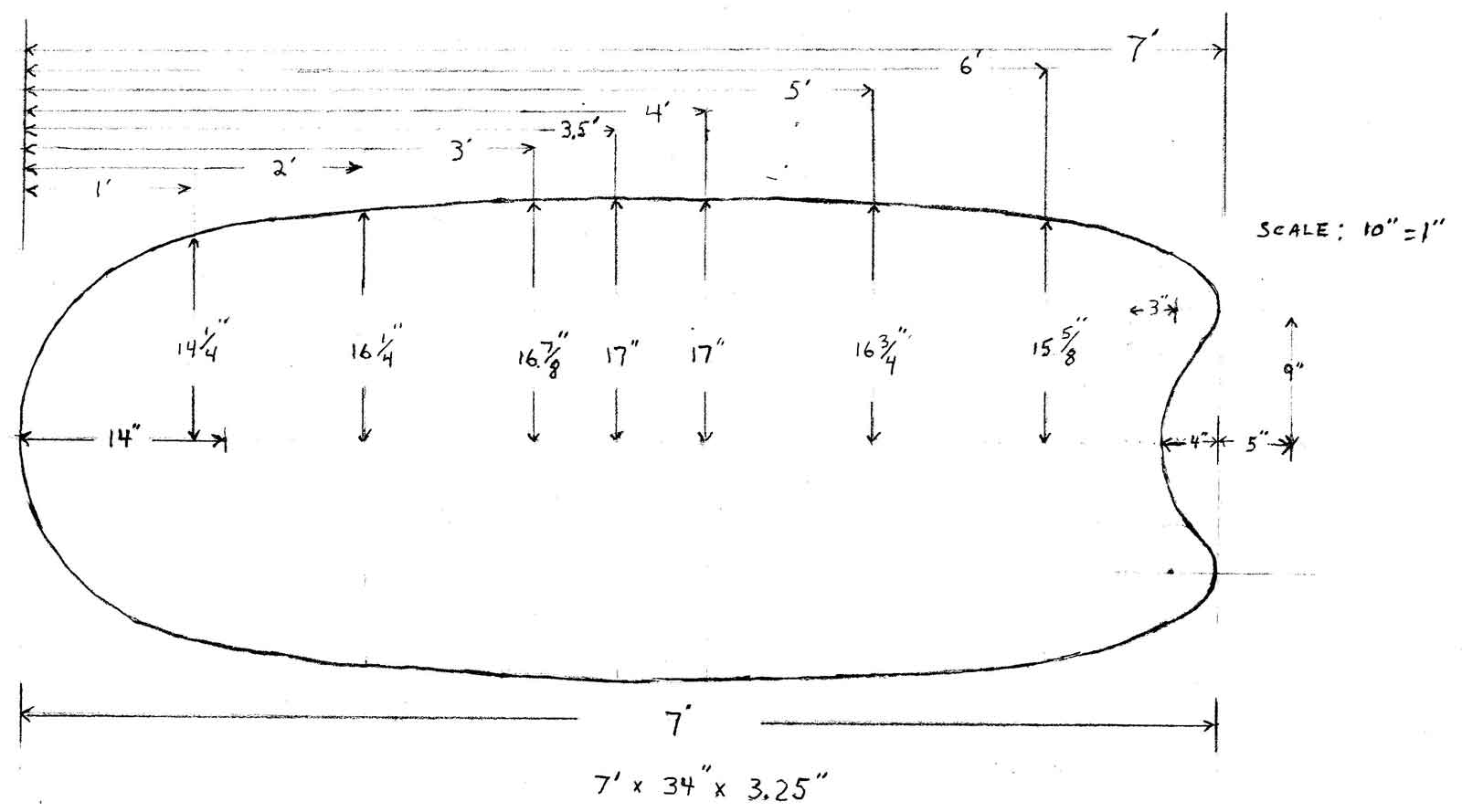
REVIEW OF 7' x 34" x 3.5" See Fig. 11 below. This experimental model is a surprise. Generally a pleasant surprise in surfability. Almost always an unpleasant surprise in responses by other surfers. The initial response by most surfers looking at it is doubt. Doubt about what it is. Doubt that it can be turned. Doubt that a paddler can get his arms into the water. Although in general, I do not recommend the design, the surfersteve group believes much can be learned by going to extremes. The lack of recommendation is more because of surfers' reluctance to knee paddle, use paddling gloves, sit on the board differently, and try something very different, than because of any of the other drawbacks listed below. The board actually works well on the open face of a clean wave. CON'S: 7' x 34" x 3.5" - Very parallel outline. 6" nose rocker. Zero tail rocker. 3.5" tail thickness 6" from end. See Fig. 11 below. 1. The following is the biggest complaint by far: 34" width is initially very uncomfortable to sit on. Riders all complained immediately of feeling as if their legs would not spread far enough. Also; transitioning from sitting to lying is awkward. These problems can be overcome by simply sitting with the legs forward or on top of the board, and pushing up with the arms when sliding the feet back. Also; if knee paddled, the rider can simply sit back from the kneeling position, with the feet on top of the board, and bisaversa. No one else was willing to make any of these adjustments. So...for the vast majority of surfers this drawback alone causes the design to be so unpleasant as to be useless. PRO'S: 7' x 34" x 3.5" .- Very parallel outline. 6" nose rocker. Zero tail rocker. 3.5" tail thickness 6" from end. See Fig. 11 below. 1. Reaches full plane earlier (at a lower speed after catching the wave), and accelerates faster compared to all other designs. Design paddles slower, and drops in later than a long-longboard or paddleboard, but will reach the same maximum speed at about the same time on the same wave, due to the longer, narrower board accelerating more gradually (will catch up to, but not pass a longer board).
TAIL COMPARISIONS, OR DO YOU THINK YOU COULD LIKE A BIG REAR END? The vast majority of surfboards have, within an inch or two, the same tail measurements, and roughly the same curvature. This seems to be the result of most surfers preferring lean type turning, and the ripping and carving feeling that can result. This type of surfing encourages surfers to be very resistant to moving their feet - they prefer to shift weight from heel to toe when turning, keeping the front and back foot near the board center line. It is unfortunate this type of tail, and the surfing that goes with it, are so dominate. There is merit to a wider tail with a more parallel rail - it allows for a shorter design, which, simply because it is shorter, almost always turns faster. As mentioned previously, this wide type of tail is more responsive if the rear foot is moved towards the rail and a twisting motion adopted. Note 5: See rocker image below, and Fig 1 through Fig 13 at end of page. Choose top rocker for 30" and 34" width. Choose bottom rocker for 28" and narrower width. 3/8" measurement in top rocker should be 1/8" Note 6: See Fig. 15 below for Fin Box position.
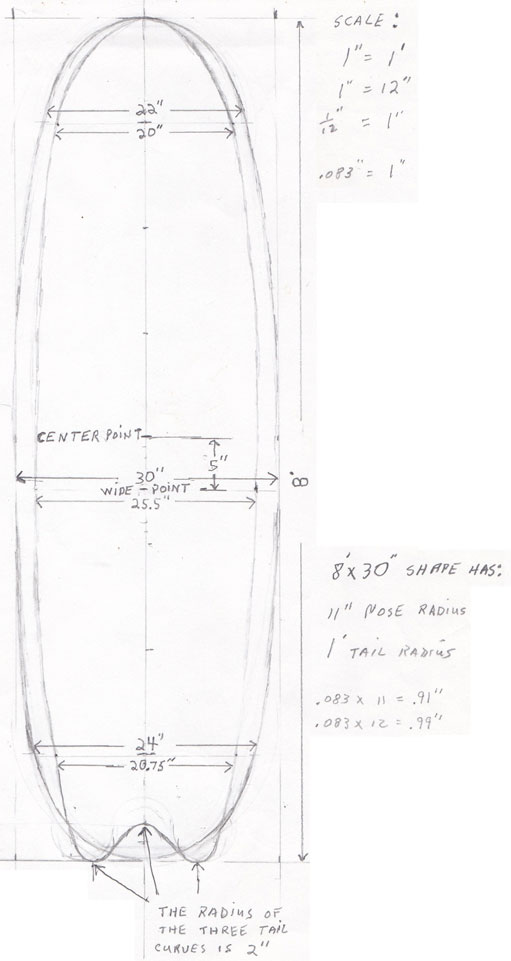
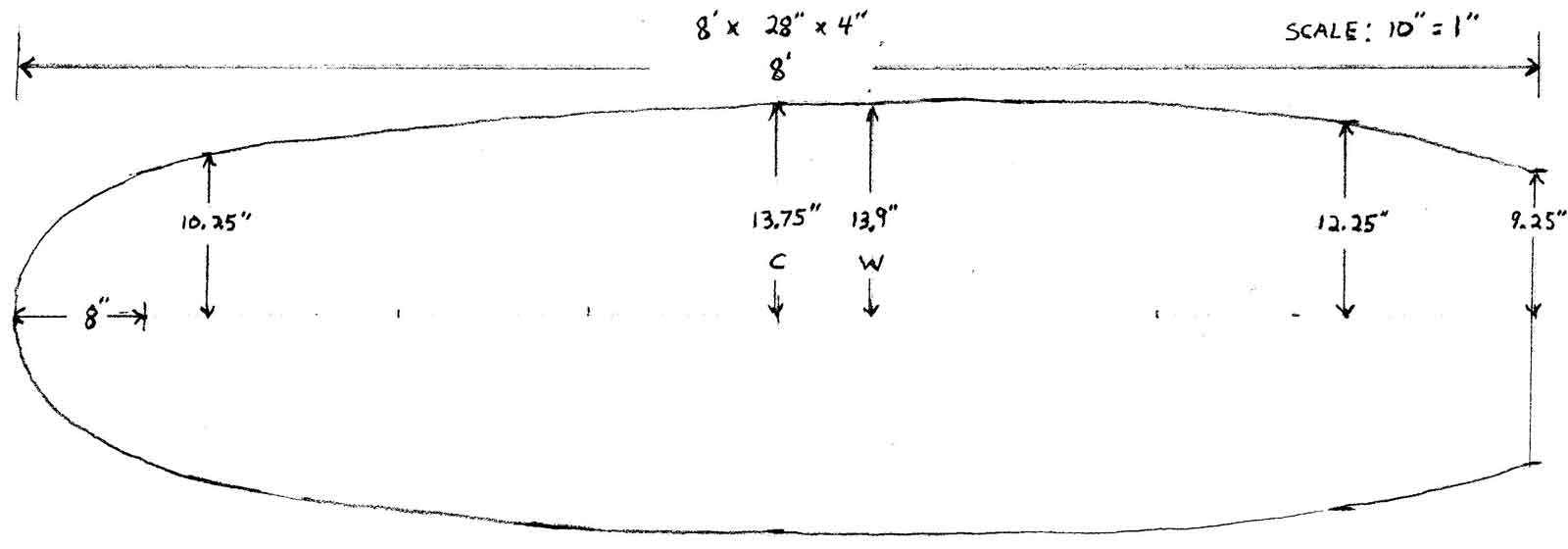
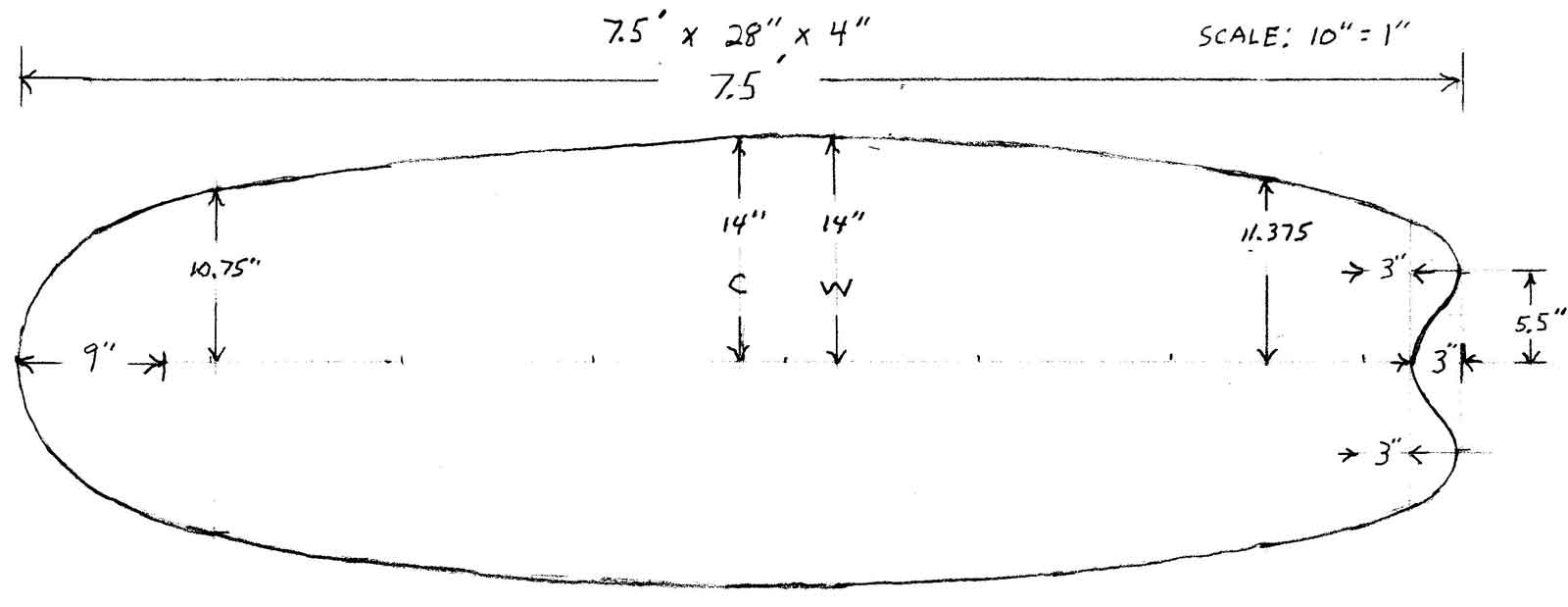
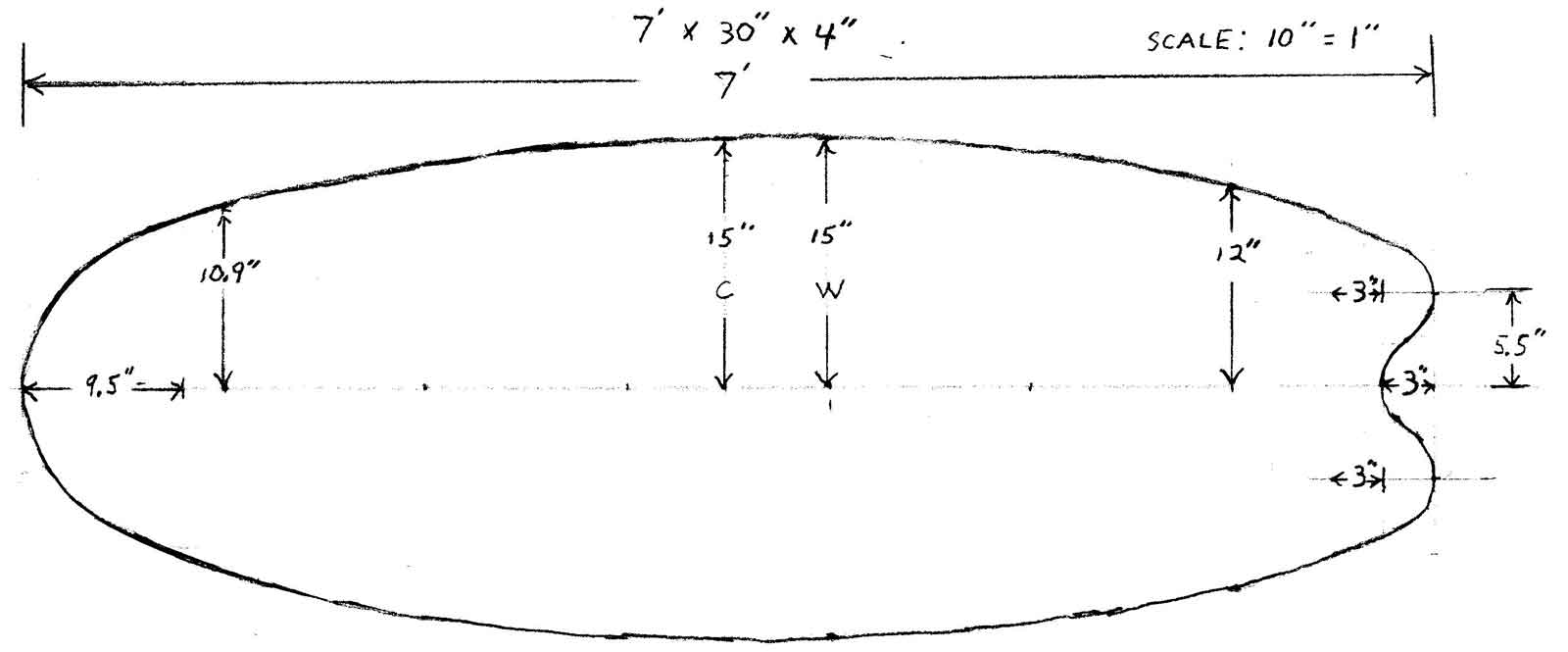
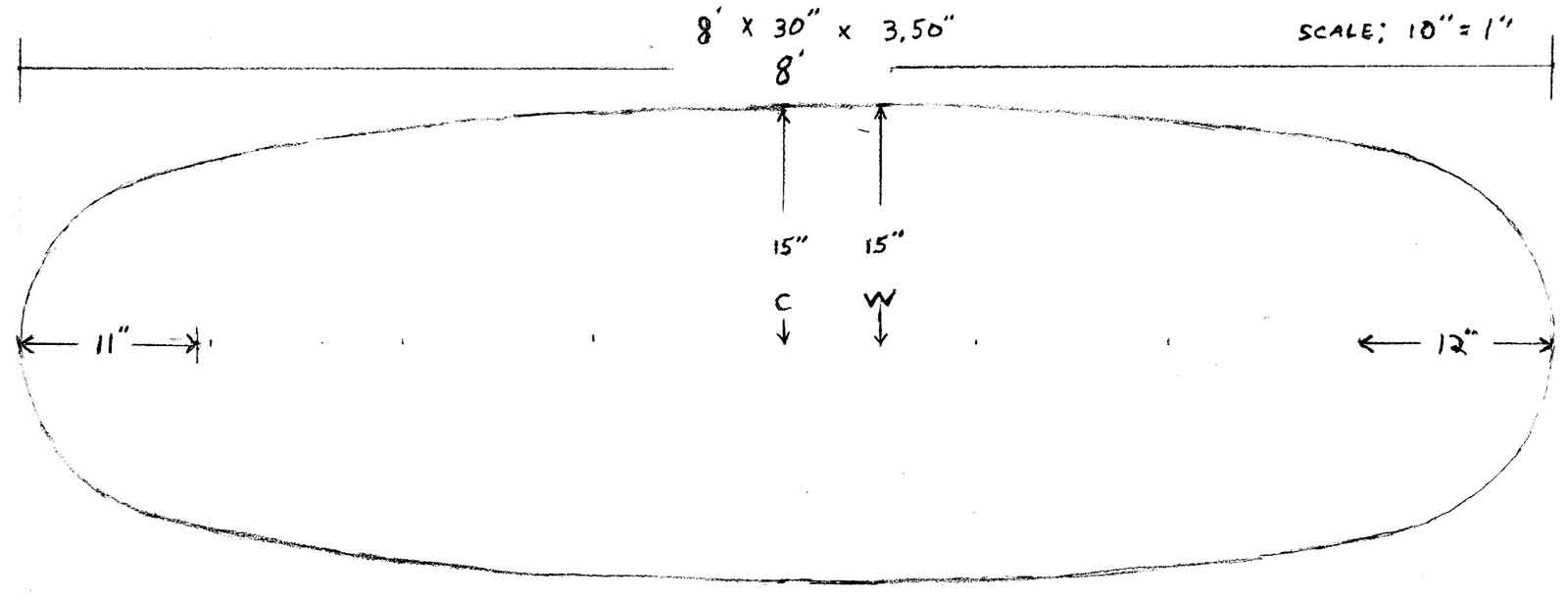
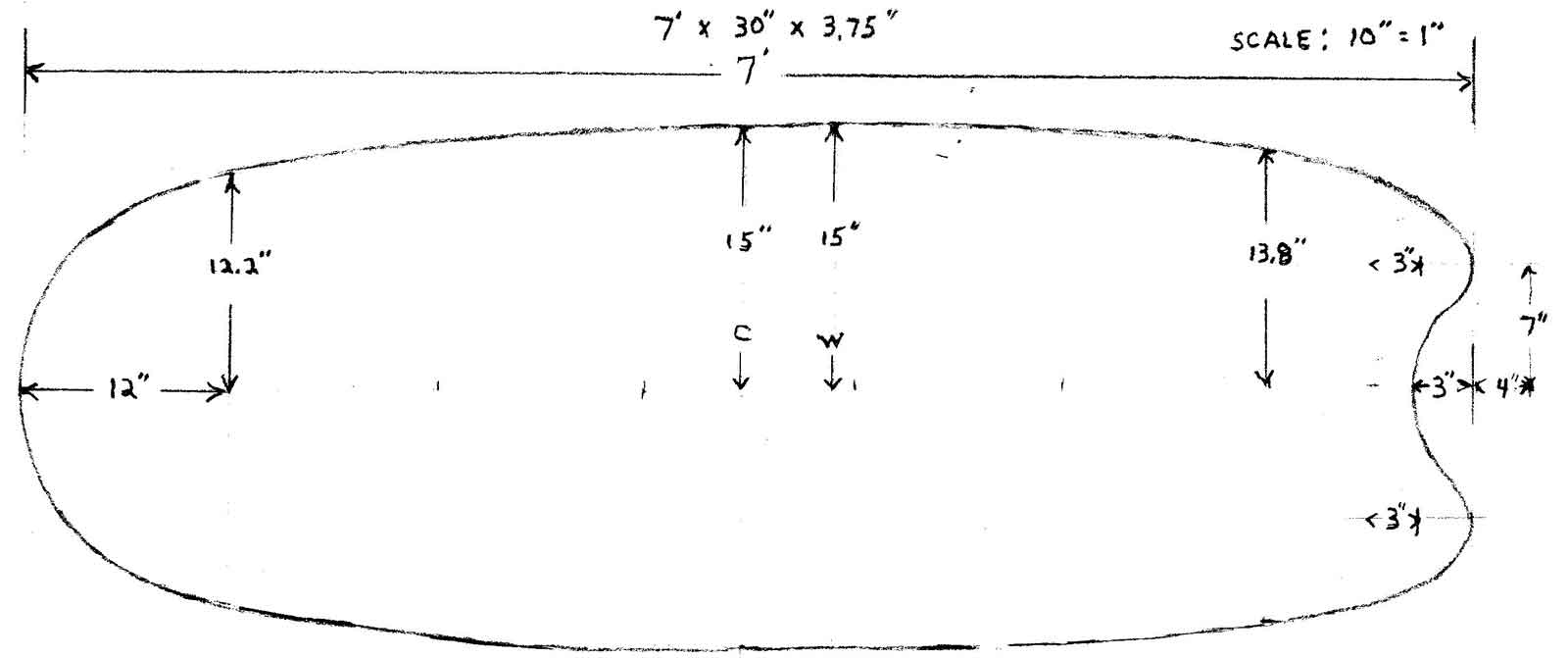
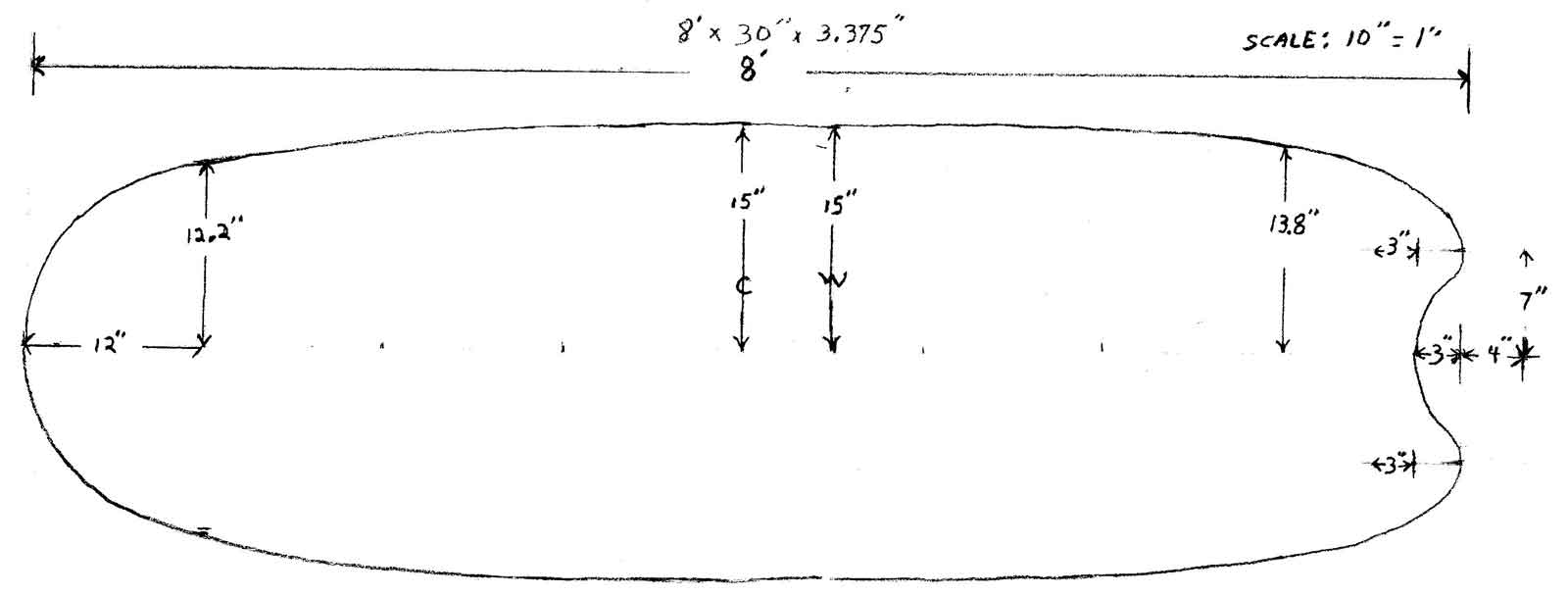
Do not use fins shown above if you are over 160 lbs. - heavier guys all preferred the molded 7" cutaway fins (full size fin, not cut down). All Small Wave Designs (not including many replicas with different thicknesses) done by the Author, in the order they were built, shown below: Note1: Fig. 1 through 15 all show radius measurements on most of the tails and noses. Fig 2 shows a nose formed from an 8" radius and three tail curves from 3" radii. Arrows touching straight lines, on the nose and tail areas denote points for center of radii. The original paper drawings have full circles shown, but these circles did not scan - sorry. Note 2: Author, in 2012, prefers Fig. 12 and Fig. 13.
Note: 11" tail in Fig. 6 is actually 9.25" Note: 9.25" tail in Fig. 7 is actually 11"
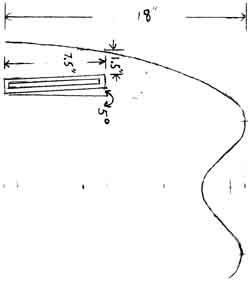
Note: Fig. 15 - Fin box. Scale 5" = 1". Front of fin box should be 17" on 25.5" version, and 19" on 30" and 34" versions. Cutting box to 5&1/2" length allows the fin, and box to be positioned closer to the rail, which improves response. Plastic squeegee has 5 degree side - perfect for setting fin boxes and fins.
|
 click on image to see full size